

BOOK LAUNCH!
SED 21: Vulnerability and Retrofitting Techniques for Non-engineered Unreinforced Masonry (URM) Buildings in Seismic Prone Countries
 Editor (and Author): Andreas Lampropoulos.
Authors: Eftychia Apostolidi, Stephanos Dritsos, Christos Giarlelis, Jose Jara, Anna Karatzetzou, Konstantinos Morfidis, Jon Moseley, Cristina Ferreira de Oliveira, Vasilis Sarhosis, Marina Traykova.
Publisher: International Association for Bridge and Structural Engineering (IABSE).
ISBN: 978-3-85748-213-7 (print). 978-2-85748-000-6 (ePub). 978-3-85748-214-4 (eBook). 111 pgs.
Typeset and Copyedited by: Structurae.
Note: Members can download this SED for free in the Members Area. Hardcopy and e-Book (ePDF) can be purchased at the Online Shop. Published in September 2026.
Unreinforced masonry structures (URM) are prevalent in under-developed and developing countries. The majority of these URM structures are not engineered, they simply follow local construction techniques and usually do not comply to any seismic standards.
After a thorough description of the methods of construction and the materials used for URM buildings all over the world, the most common seismic damage and failures types for each system are presented and explained through figures and actual case study pictures. Then the book focuses on the low-cost repair, strengthening and retrofitting tailored for non-engineered (URM) buildings in seismic-prone regions. Emphasizing on local and global stability, it encompasses a diverse spectrum of strengthening approaches. Each technique is meticulously described, providing insights into its range of applications, the basic scientific concept and key considerations for the design and the application process. Through meticulous planning and execution, these techniques enhance seismic resilience while considering factors such as building condition, seismic hazard, and cultural significance.
This state-of-the-art document encompasses the knowledge assimilated from the effect of past seismic events on different types of URMs and aims to empower communities in safeguarding lives and heritage against seismic hazards providing solutions both cost-effective and comprehensive. It focuses on low-cost seismic repair, strengthening and retrofitting techniques, considering the main URM structural typologies and respective seismic failures in under-developed and developing countries and could serve as a useful tool for practical engineers and designers.

Structural Engineering Documents 20: Sustainability in Structural Concrete Design

Edited by: Jorge de Brito and Rui Vasco Silva
ISBN: 978-3-85748-201-4, 376 Pages, English.
Publisher: International Association for Bridge and Structural Engineering (IABSE).
Typeset and Copyedited by: Structurae. To get an overview of the book click here.
Purchase a Hard Copy /eBook: Click Here
Note: Members can download this SED for free in the Members Area. Hardcopy and e-Book (ePDF) can be purchased at the Online Shop. SED 20 Preview
Sustainability in construction is a priority for both academia and industry to reduce the carbon footprint of the built environment and thus combat climate change. Numerous approaches have been developed on how to tackle this issue, wherein the implementation of eco-efficient concrete is currently considered one of the most effective measures to be applied at the beginning of a building’s life cycle. This edition of the Structural Engineering Document discusses key issues in selecting and incorporating eco-efficient waste materials capable of enhancing the sustainability of structural concrete in construction projects. The cost-efficiency of using recycled aggregates in structural concrete is shown by several world-renowned researchers. Critical evaluations and case studies further highlight the properties and performance of these materials and in various structural applications. Also, novel low-impact binding systems using industrial by-products showcase the importance of continuous research for technically viable alternatives capable of decreasing the huge dependency on ordinary Portland cement. The purpose of this document is to contribute to a broader understanding of the many possibilities for the development of a more sustainable structural concrete, thereby fostering resilient and sustainable construction practices to support the global commitment to environmental responsibility.
Structural Engineering Documents 19: Seismic Isolation and Response Control
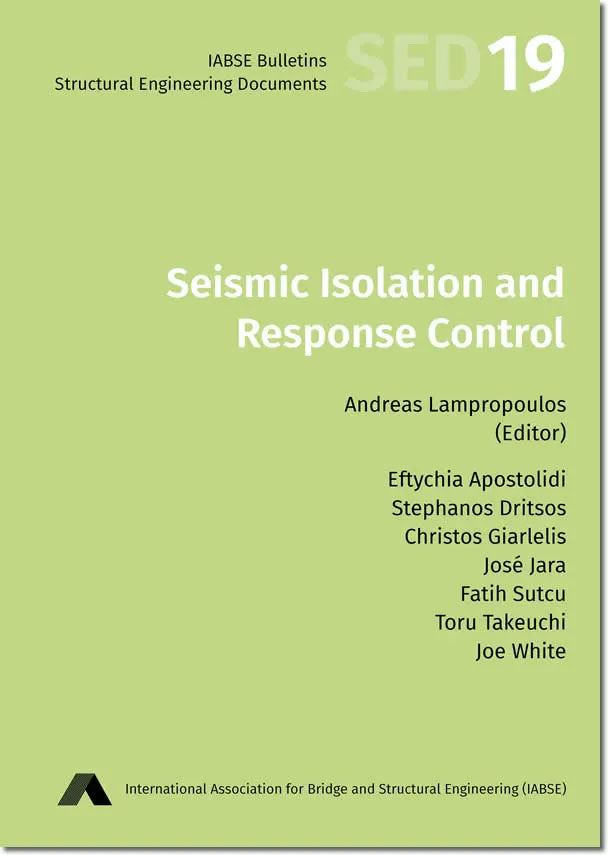
Edited by Andreas Lampropoulos.
Reviewers: Fabrizio Palmisano (Chief Reviewer), Bahadur Sadan and Alberto Pavese (External Reviewers).
ISBN: 978-3-85748-180-2 (print). eISBN: 978-3-85748-179-6 (PDF), 978-3-85748-182-6 (ePUB).
DOI (Click Here). Size: 170 x 240 mm. Published: December, 2021. Available at: www.iabse.org/onlineshop
111 pages, in English. SED 19 Preview
Publisher: International Association for Bridge and Structural Engineering (IABSE).
Typeset and Copyedited by: Structurae.
Watch the video with the Editor and Authors describe the book (Click Here)
Note: Members can download this SED for free in the Members Area. Hardcopy and e-Book (ePDF) can be purchased at the Online Shop. This book has also been translated into Chinese by CABP and is available in China: Click Here.
Summary: The seismic resilience of new and existing structures is a key priority for the protection of human lives and the reduction of economic losses in earthquake prone areas. The modern seismic codes have focused on the upgrade of the structural performance of the new and existing structures. However, in many cases it is preferable to mitigate the effects of the earthquakes by reducing the induced loads in the structures using seismic isolation and response control devices. The limited expertise in the selection and design of the appropriate system for new and existing structures is the main challenge for an extensive use of seismic isolation and response control systems in practice.
This document aims to provide a practical guide by presenting a collection of the most commonly used seismic isolation and response control systems and a critical evaluation of the main characteristics of these systems. Comparisons of the key parameters of the design processes for new buildings with seismic isolation are presented, while the application of seismic isolation systems and response control systems for the retrofitting of existing structures is also examined, followed by various case studies from Greece, Japan Mexico New Zealand, and Turkey.
IABSE Bulletin Board: IABSE Bulletin Board: D. Laefer, (Chair), F. Palmisano (Vice-Chair), H.Subbarao, M. Bakhoum, C. Bob, M.W. Braestrup, N.P. Hoej, H.H. Snijder, R. Mor, M.G. Bruschi, S. Kite, F. Nalon, G. Pircher, M. Knobloch, A. Schumacher, O. Larsson Ivanov, F. Nalon, Y. Offir, S. Dan, Y. Xia, V.Samec, A.Palermo.
Click here to view the complete list of published SEDs.


